Running Away from the Yonic Abyss
Jesus can always reject his father
But he cannot escape his mother's blood
He'll scream and try to wash it off of his fingers
But he'll never escape what he's made up of
-Ethel Cain, Family Tree (Intro)
Running Away from the Yonic Abyss
This blog is about those Ethel Cain lyrics. About the human condition. About what drives us and what gives us ecstasy and despair. I will put two books in conversation, Ernest Becker’s The Denial of Death and Camille Paglia’s Sexual Personae. Both are beautifully written and talk of similar ideas: Becker is easier to take seriously, but Paglia is just deliciously entertaining, so I feel compelled to unite them, create the best of both worlds, before I lay out my beef with it.
Becker believes that “our central calling, our main task on this planet, is the heroic“ (p. 1). Everyone needs a main character narrative to drive their life, to make them feel like a hero, like they matter in this world. This is man’s tragic destiny: “he must desperately justify himself as an object of primary value in the universe; he must stand out, be a hero, make the biggest possible contribution to world life, show that he counts more than anyone else“ (p. 4). As such, society is but a “symbolic action system, a structure of statuses and roles, customs and rules for behavior, designed to serve as a vehicle for earthly heroism“ (p. 4).
Man has a paradoxical nature, he is “half animal and half symbolic“ (p. 25). But we do not value these equally, Becker claims. We love the symbolic part, which Becker calls “[that] immense expansion, [that] dexterity, [that] ethereality, [that] self-consciousness [which] gives to man literally the status of a small god in nature, as the Renaissance thinkers knew“ (p. 26). The animal is detestable, however; Becker invokes the Eastern sages as a contrast, which remind us that “man is worm and food for worms… this is the paradox: he is of nature and hopelessly in it; he is dual, up in the stars and yet housed in a heart pumping, breath-gasping body that once belonged to a fish and still carries the gillmarks to prove it“ (p. 26).
Becker has a common conception of a split human nature, half mind and half body. He says that we have “two distinct kinds of experience — physical and mental, or bodily and symbolic“ and thus “the problem of self-perpetuation presents itself in two distinct forms“ (p. 231). But Becker claims that the symbolic is superior, the one we truly need and desire, the one that makes life worth living: “[t]he distinct human problem from time immemorial has been the need to spiritualize human life, to lift it onto a special immortal plane, beyond the cycles of life and death that characterize all other organisms“ (p. 231). Our animal nature reminds us that we’re nothing but sacks of meat, reminds us of our mortality, that we are nothing but a speck of dust in the cosmos. Our animal nature contradicts the beautiful delusions of our symbolic nature, which seek immortality and transcendence. Becker’s central drive to explain the human condition is the fear of death, that repressed and re-directed anxious force behind the drive for “limitless self-expansion“, behind the “pleasures of incorporation… the desire to stand out, to be the one in creation“ (p. 3). The prerogative of our human nature is to reconcile the immortality drive of the symbolic self and the mortal nature of our animal self, and human life is nothing but the attempts of the symbolic to overcome the animal, repudiate creatureliness. After all, “culture opposes nature and transcends it. Culture is in its most intimate intent a heroic denial of creatureliness.“ (p. 159)
Let’s spice it up! Paglia agrees with this, but she takes it further. Much, much further. Paglia believes that women are nature and men are culture. Becker’s conception of human nature as the half-symbolic running away from the half-animal, as the quest for heroism, is a seen by Paglia as a pathetic yet triumphant attempts by men to run away from women, from their implied femininity. Paglia points at the cross-cultural association between women and nature, both fecund and dangerous, creative and destructive:
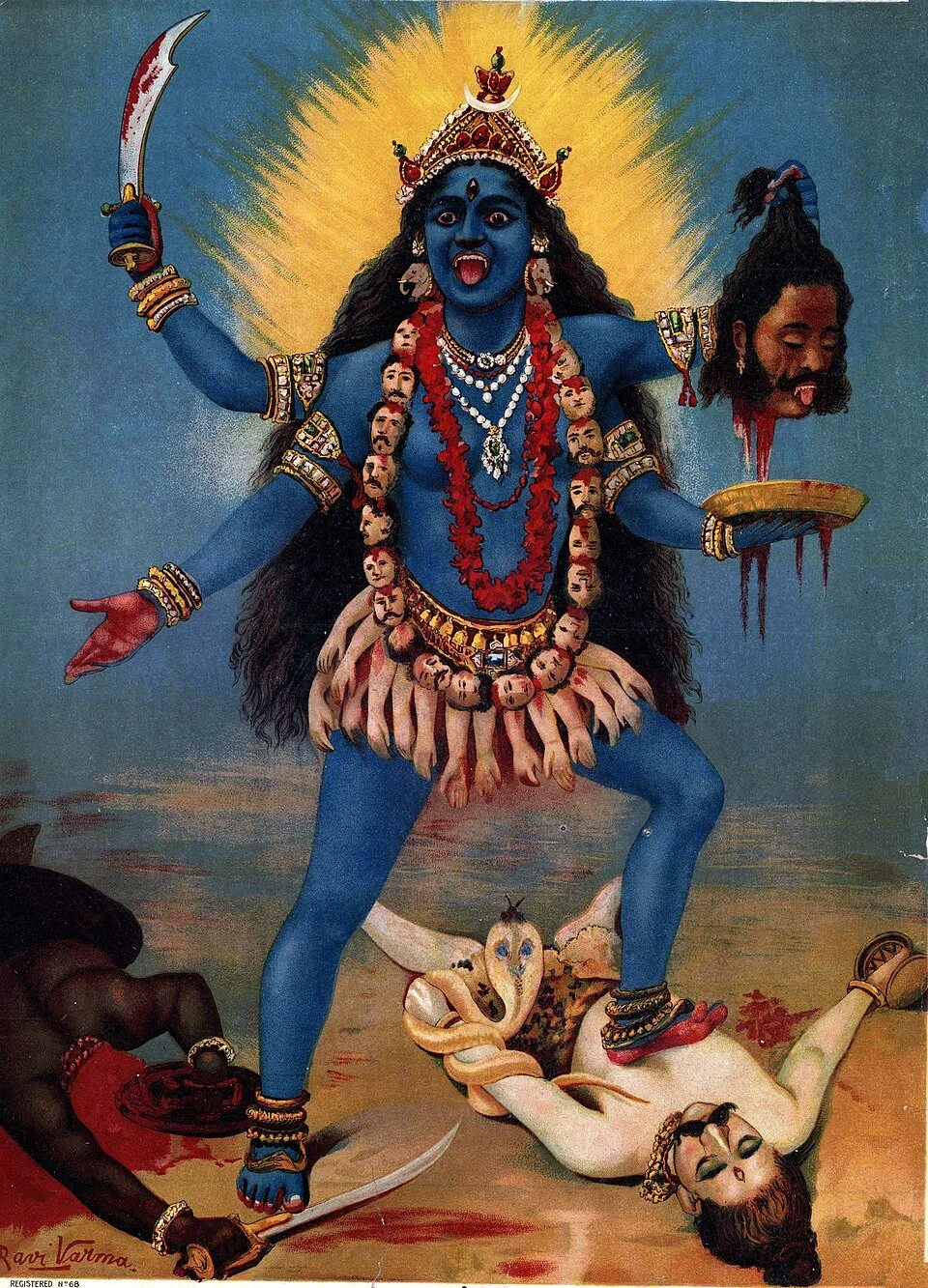
Kali by Raja Ravi Varma
“Nature’s cycles are woman’s cyles. Biologic femaleness is a sequence of circular returns, beginning and ending at the same point. Woman’s centrality gives her a stability of identity. She does not have to become but only to be… Woman does not dream of transcendental or historical escape from the natural cycle, since she is that cycle.“ (p. 9-10)
Woman’s centrality in nature is seen by men as an obstacle, a “symbolic burden of man’s imperfections, his grounding in nature. Menstrual blood is the stain, the birthmark of original sin, the filth that transcendental religion must wash from men“ (p. 11). Here are Ethel Cain’s lyrics in context: “[man] must transform himself into an independent being, that is, free of [the woman]. If he does not he will simply fall back into her. Reunion with the mother is a siren call haunting our imagination.“ (p. 9-10). Women and nature “stand ever ready to reduce the male to boy and infant” (p. 27). So men have banded together and invented culture as a protest to both women and nature, “as a defense against female nature“ (p. 9).
What is the basis for this, somehow both misogynist and misandrist, gender essentializing? It’s neither socialization nor genes. Rather it is some sort of embodied cognition that is based on anatomy. Paglia claims that she is using an “analogy between sexual physiology and aesthetics” (p. 17) to make these claims:
“Men is sexually compartmentalized. Genitally, he is condemned to a perpetual pattern of linearity, focus, aim, directedness. He must learn to aim, Without aim, urination and ejaculation end in infantile soiling of self or surroundings… Male sexuality is inherently manic-depressive… [they] are in a constant state of sexual anxiety, living on the pins and needles of their hormones. In sex as in life they are driven beyond — beyond the self, beyond the body.. But to be beyond is to be exiled from the center of life… They wander the earth seeking satisfaction, craving and despising, never content. There is nothing in that anguished motion for women to envy.“ (p. 19)
Woman, claims Paglia, may choose to achieve, but they do not need it. Men on the other hand are out of balance, they must “quest, pursue, court, or seize“ (p. 20). We’re just warming up. Paglia names some examples: “an erection is a thought and the orgasm an act of imagination” (p. 20) and “male urination really is a kind of accomplishment, an arc of transcendence. A woman merely waters the ground she stands on.. Women, like female dogs, are earthbound squatters.“ (p. 21). Such “male projection of erection and ejaculation is the paradigm for all cultural projections and conceptualization — from art and philosophy to fantasy, hallucination, and obsession.“ (p. 20). Women are one with nature, so they are centered in their identity, but men are out of balance, and they need to prove that they are men to themselves and others. Falling back to the mother is a grotesque failure in the quest for the heroic.
Falling back to the mother for Paglia is similar to the idea of the denial of death for Becker. Women serve to remind men of their creaturliness, of their inevitable death, to reduce them to nothingness. It is the symmetry of “womb and tomb“, they came from nothingness and they will return there. The association of women and nature is always double-edged according to Paglia. Like the Indian Goddess Kali, she is both the creator and the destroyer. The toothed vagina, a cross-cultural folklore motif is evidence for Paglia for such “gruesomely direct transcription of female power and male fear“ (p. 13), as is the tropes of the femme fatale in more modern media.
Becker is less sensationalist in his writing, but even he seems to flirt with such ideas. He says that both boys and girls “turn away from the mother as a sort of automatic reflex of their own needs for growth and independence“ (p. 39) and that the father “seems more neutral physically, more cleanly powerful, less immersed in body determinisms; he seems more “symbolically free,“ represents the vast world outside of the home, the social world with its organized triumph over nature, the very escape from contingency that the child seeks“ (p. 39). Becker does not see the quest for heroism as more the domain of men compared to women, but heroism is escaping the Mother, that “goddess of light“ but also the “witch of the dark“. The way to conquer the fear of death is by becoming the “father of yourself“ (p. 35), by “carving out a place in nature, by building an edifice that reflects human value: a temple, a cathedral, a totem pole, a skyscraper, a family that spans three generations“ (p. 5). Paglia would say, that is a penis, penis, penis, penis, and penis.
I don’t think that this idea is essentially wrong — I can see how this quest for heroism and fear of death is a strong drive, from deep within our human nature. I am also not going to try and refute Paglia’s gender narrative around it, I just don’t take it too seriously and it is kind of entertaining in its conviction and irreverence. I do think that there is some grain of truth to it, not a stereotypical truth that reduces individuals to their gender-determined destiny, but rather an archetypal truth. My problem with this theory is that it is not complete. It is only a part of the story. Yes, humans are running away from death toward immortality, from the Mother to the Father, from nature to culture. But they also run in the opposite direction! And that direction is toward something so fundamental to our existence as humans, yet so suspiciously absent in both books — love.
Running Toward the Yonic Abyss
The conclusion of any theory about human nature is as good as its assumptions. This one glorifies the symbol in us and denigrates the animal, it glorifies culture and denigrates nature. Where can such a theory end? How do we solve the inherent absurdism of our condition? Both Becker and Paglia suggest that art is a brilliant solution (with which I strongly agree), but that sex is doomed to fail (which which I strongly disagree). Both Paglia and Becker are suspicious of sex as a tool to deal with our human condition. Becker agrees with Gorky that “slavishness is in the soul”, and pleads that we avoid other people as means to our immortality project; he warns that a common outlet for our quest for heroism and immortality is through other people. In desperate attempts to infuse the heroic in our lives, we cast our daily lives as husbands, wives, sons, daughters, citizens, and our prescribed roles and responsibilities, as our heroic life narrative. But other people cannot give us cosmic significance, and our live becomes a “reflexive dialogue with the standards of our wives, husbands, friends, and leaders“ (p. 202). Becker warns against the “romantic solution“, whereupon one fixes “the urge to cosmic heroism onto another person in the form of a love object“ (p. 160). During sex, the body and the mind merge, but also two bodies merge, now “four fragments of existence melt into one unity“ (p. 162). But this is not a beautiful ceremony of love, for “sex is of the body, and the body is of death“ (p. 162). Sex awakens our creatureliness, reminds us of our animality and mortality, reduces us to no symbol and all animal, no individuality, just exchangeable sacks of meat ferally driven to achieve its organismic purpose of reproduction. Paglia agrees, she says that sex “really is a kind of drain of male energy by female fullness“ (p. 13), an “uncanny moment of ritual and incantation, in which we hear woman’s barbaric ululation of triumph of the will. One domination dissolves into another. The dominated becomes the dominator“ (p. 26). Men may socially dominate women, but this is simply a response of an out-of-balance anxious boy, so intent on escaping the dissolving grips of his Mother, yet cursed to have to return to her, dipping his skyscraper, that embodiment of his immortality project, into her devouring yonic abyss, that womb-tomb, from which everything came, and to which everything will return. Sex is not a ritual of bonding, it is a reminder of the futility of life.
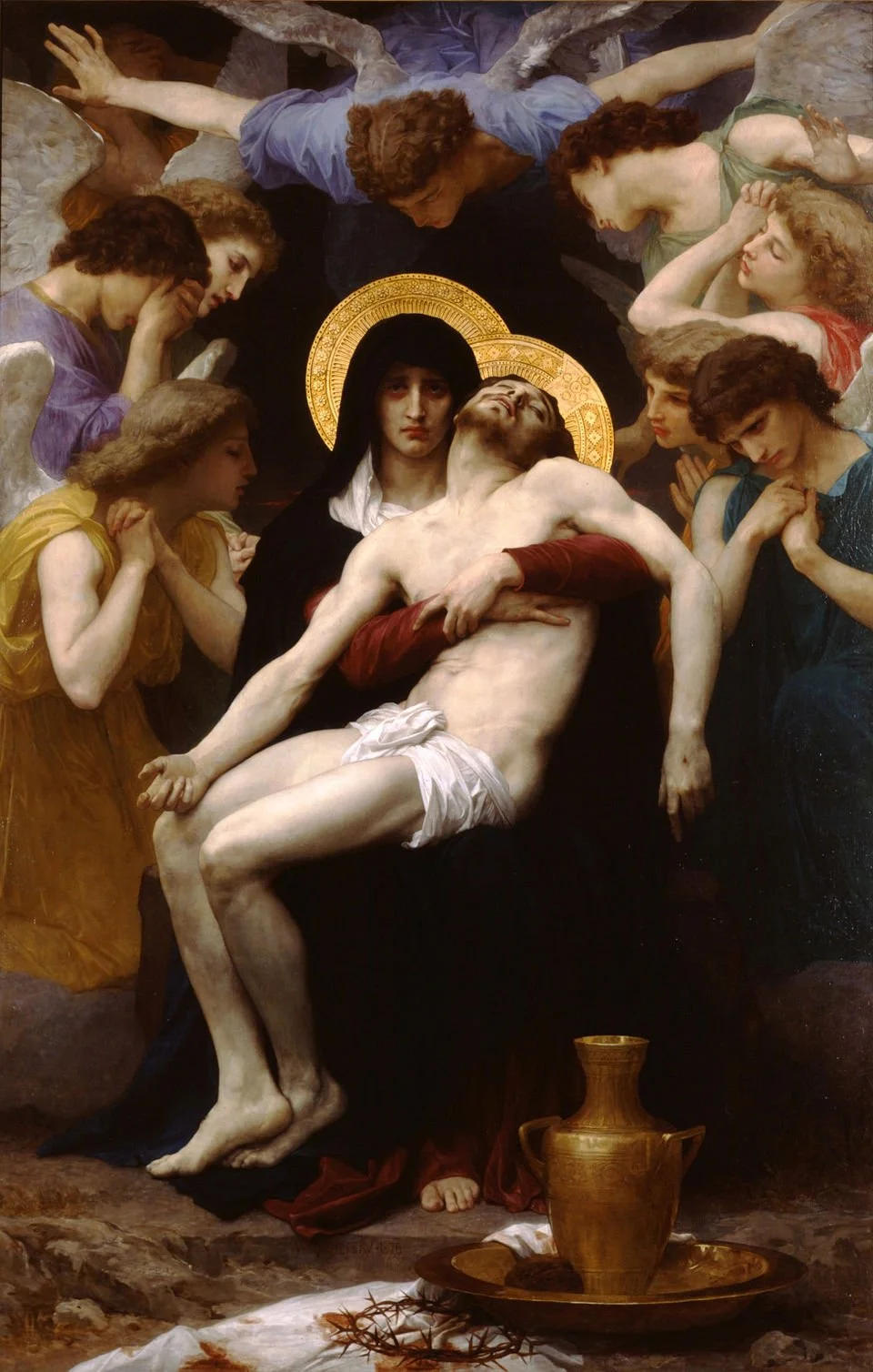
Pieta, by William-Adolphe Bouguereau
How Becker and Paglia treat sex relates to broader themes of running away from other people, of treating others as incidental or damaging to the causa-sui immortality project. If others are there, they are not there to be loved, to be served and submitted to, to be merged and united with. They are there to witness our heroism, to applaud. The solution both Becker and Paglia prescribe is perhaps not surprising for someone who rejects nature and embraces culture, who rejects mommy and embraces daddy. Becker looks to the sky and says religion is the best solution, and advocates that we each become “a knight of faith“, following Kierkegaard. Paglia too loves the masculine order she associates with culture, claiming that “[h]appy are those periods when marriage and religion are strong“ (p. 25) and that it is “patriarchal society that has freed [her] as a woman“ (p. 37). How ironic. Running away from the Devouring Mother, both Becker and Paglia end up being slaves for Daddy. Daddy in the sky, Daddy the idea.
Where is love in all of this? Is there no drive towards others? Both authors flirt with this idea. Becker rightly sees the dangers of too much heroism, of alienation and isolation. He calls this twin motive the “fear of life“. This is why, Becker claims, we cling to our families and friends, to human-centered immortality projects. Life is overwhelming in its wholeness, and being in community means that we have a shared meaning that protects us from too much life, that gives clear answers to scary questions about life and death. But, this is not a drive toward others that is conceptualized around love, around serving and giving, around a masochistic devotion to someone, like the figure of Mother Mary is toward Jesus, or the figure of Jesus is toward humanity. This is a drive toward others that is about soothing of the fears of the ego, of balancing a god-complex. Paglia says “[o]nly in society can one be an individual“ (p. 39) — the goal is to be an individual and everyone else either a supporting actor or an audience to our starring role performance.
But there is more to life than this. Society is not just an audience, and love is not an illusion of slavishness. Death is followed by a Resurrection, Mother is Destructive but also Creative and Loving. Sabina Spielrein hypothesizes a Death drive, not as a pleasure of incorporating others, but as a masochistic drive to die into others, into a community into which one dissolves and has their ego reborn as the true heroic self. To die with service and love, with devotion and help. To paraphrase her, where Love reigns, Ego, that ominous despot, dies.
Spielrein analyzes Nietzsche’s writing in The Birth of Tragedy as a patient zero of the Death drive. Nothing better than his words to point out the gap in Becker and Paglia’s theories. Nietzsche says that “the best of all things is something entirely outside your grasp: not to be born, not to be, to be nothing“ (p. 22). How could being nothing be desirable for Nietzsche? This is definitely not a fear of death, but it is also not a fear of life either. Nietzsche is not hiding from the overwhelming experience of life, of the infinite in the cosmos — he is seeking it:
“We are pierced by the raging goad of those torments just as we become one with the vast primal delight in existence and sense the eternity of that delight in Dionysiac ecstasy. For all our pity and terror, we are happy to be alive, not as individuals, but as the single living thing, merged with its creative delight“ (p. 81)
Nietzsche knows that Mother is destructive and creative, he knows that the ego needs to die to be reborn, and he is ready to be beheaded by Kali so he can be held in Mother Mary’s hands. Nietzsche cannot get to love, to “become one with the vast primal delight in existence“ by listening to Becker and Paglia. They fear Death, they advise against others that Nietzsche knows we need to fuse with. Paradoxically, the causa-sui project of immortality requires death. Death that involves serving, giving, listening, helping, being in community. This means that fulfilling the quest for heroism that Becker and Paglia claim is at the basis of human nature, requires that we first abandon it. As the Dao says, bow down, then be preserved. No purer, more ecstatic immortality than the one of the single living being, the one by Mother’s side, being nothing yet full of love. As Becker and Paglia run away from the Yonic Abyss, the Mother tells them:
“Be like me! The Primal Mother, eternally creative, eternally impelling into life, eternally drawing satisfaction from the ceaseless flux of phenomena!“ (p. 80)
Note: Thumbnail features Georgia O’Keefe’s Red Canna (1924).